

If your oven stopped heating, it’s almost always one of four things: a burned-out bake or broil element (most common in electric ovens), a faulty igniter that can’t get the gas to light, a broken temperature sensor that sends the wrong signal to the control board, or a failed control board that won’t send power to anything at all. Each one has different symptoms and a different fix. The sections below walk through each cause so you can figure out which one you’re dealing with before calling for oven repair or grabbing a screwdriver.
Why is my oven not heating up?
Perfect Appliance Repair Tampa
What causes an oven to stop heating?
Burned-out bake or broil element (electric ovens)
The bake element sits at the bottom of the oven cavity; the broil element is at the top. When either one fails, you’ll see a visible crack, blister, or burn mark on the coil, and the oven won’t reach temperature. Bake element replacement runs $150–$300 with labor. It’s one of the more DIY-friendly oven repairs if you’re comfortable with basic electrical work.
Faulty igniter (gas ovens)
The oven igniter glows orange to light the gas burner. When the igniter weakens, it draws too little current to open the gas valve, so the burner never lights. A gas oven not heating because of a weak igniter is the single most common gas oven complaint. You may hear clicking or see the igniter glow but no flame. Igniter replacement typically costs $120–$250 parts and labor.
Temperature sensor failure
The oven temperature sensor is a thin probe mounted inside the oven cavity, usually in the back upper corner. When it fails, the oven either overheats or shuts off early because the board is reading a false temperature. You can test it with a multimeter — at room temp it should read around 1,080 ohms. A bad sensor usually runs $80–$180 to fix.
Control board failure
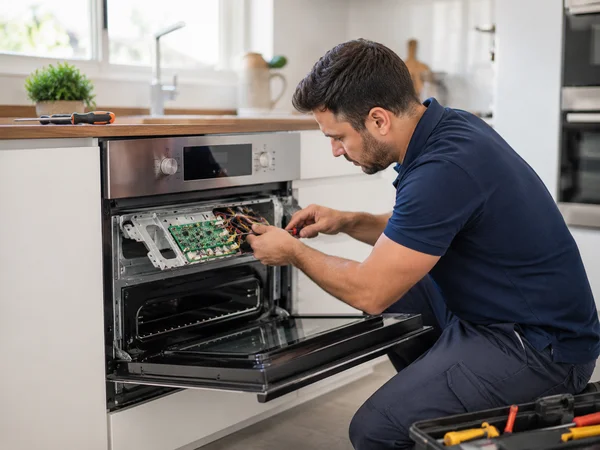
The electronic control board is the oven’s brain. When it fails, you may get error codes on the display, buttons that don’t respond, or an oven not heating at all despite working elements. Control board replacement is expensive ($200–$600) and almost always needs a professional because of programming requirements and the risk of installing the wrong board.
Thermal fuse blown
A thermal fuse is a one-time safety device that trips if the oven overheats. Once blown, it cuts power to the bake circuit entirely. It’s cheap to replace ($10–$30 for the part), but getting to it usually means pulling the oven out from the wall and disassembling the back panel. Worth checking if the oven is completely dead with no error codes.
Oven not reaching set temperature
If the oven heats but falls short — you set 375°F and get 325°F — the issue may be calibration, a weak element, or a partially failing sensor. Most modern ovens let you offset the temperature in the settings menu. If recalibrating doesn’t fix it, the sensor or element is likely going. An oven repair tech can test both components in one visit.
How to troubleshoot an oven that won't heat
Before you call anyone, run through these steps. Most take five minutes and can save you a service call.
- 1. Check the circuit breaker or gas valve. An electric oven needs a double-pole 240V breaker. If one leg trips, the oven may partially power on but not heat. Reset the breaker. For gas ovens, confirm the shutoff valve behind the stove is fully open.
- 2. Inspect the heating element visually. Pull the oven racks and look at the bake element on the floor of the oven. A burned-out element often has a crack, a hole, or a blistered spot. Same with the broil element at the top. If you see damage, replacement is straightforward on most models — usually two screws and a wire connector.
- 3. Test oven temperature with a thermometer. An oven thermometer costs $10 and tells you whether the oven is heating at all, heating low, or heating inconsistently. Set the oven to 350°F and check after 20 minutes. This tells you if you have a calibration issue or a full failure.
- 4. Check the display for error codes. Most modern ovens flash a fault code when something specific fails. Write it down and search it with your oven’s model number — it usually points directly to the failed part.
- 5. Replace the igniter (gas ovens, DIY-friendly). If your gas oven igniter glows but doesn’t light the burner, or takes more than 90 seconds to light, it’s weak. Igniters are a legitimate DIY fix on most freestanding gas ranges — the part is $20–$60 and the swap takes about 20 minutes. No gas line work involved.
What you should NOT do yourself: anything involving the gas supply line, gas valve, or gas manifold. If you smell gas, turn the stove off, open windows, leave the house, and call your gas company from outside. That’s not an oven repair situation — that’s a safety emergency.
When to call an appliance repair tech
Some oven problems are worth a DIY attempt. Others aren’t. Here’s where the line is.
- You smell gas. Don’t troubleshoot. Don’t flip switches. Get everyone out and call your gas company immediately. If the smell clears and there’s no leak, then call for oven repair to diagnose what’s going on with the igniter or valve.
- The control board needs replacement. This isn’t just swapping a part. Wrong board, wrong programming, or a bad installation can fry other components. A tech will source the correct board for your model and verify it’s communicating with the rest of the oven before they leave.
- The element keeps burning out. If you’ve replaced the bake element twice in two years, something else is causing the failure — a voltage issue, a control board sending too much power, or a wiring problem. A good oven repair tech will catch the real cause instead of just replacing the part again.
- The oven is off by more than 25°F. Small calibration drift is normal and adjustable in settings. But if your oven is consistently 50°F or more off, the oven temperature sensor is likely failing and needs testing with a multimeter and possibly replacement.
Gas ovens specifically: if the igniter glows but the burner won’t light after 90 seconds, and you’ve already confirmed the gas valve is open, call a tech. Forcing the igniter to run longer than it’s designed to can damage the gas valve.
- 1. You smell gas. Don't troubleshoot. Don't flip switches. Get everyone out and call your gas company immediately. If the smell clears and there's no leak, then call for oven repair to diagnose what's going on with the igniter or valve.
- 2. The control board needs replacement. This isn't just swapping a part. Wrong board, wrong programming, or a bad installation can fry other components. A tech will source the correct board for your model and verify it's communicating with the rest of the oven before they leave.
- 3. The element keeps burning out. If you've replaced the bake element twice in two years, something else is causing the failure — a voltage issue, a control board sending too much power, or a wiring problem. A good oven repair tech will catch the real cause instead of just replacing the part again.
- 4. The oven is off by more than 25°F. Small calibration drift is normal and adjustable in settings. But if your oven is consistently 50°F or more off, the oven temperature sensor is likely failing and needs testing with a multimeter and possibly replacement.
Oven repair in Tampa Bay, FL
Perfect Appliance Repair Tampa fixes electric and gas ovens throughout Tampa Bay, same day in most cases. Mike has been diagnosing oven repairs in this market for 19 years, and Florida homes run their ovens hard — the humidity alone accelerates wear on igniters, sensors, and control boards. Perfect Appliance Repair Tampa gives you a firm price before any work starts, no diagnostic guessing. Call or book online today.
Common questions about oven not heating
Why is my oven not heating up?
The most common reasons an oven stops heating are a burned-out bake element (electric ovens), a faulty oven igniter (gas ovens), a failed oven temperature sensor, or a bad control board. Run a visual check on the element first — it's the quickest thing to rule out.
How much does it cost to fix an oven that won't heat?
Oven repair costs vary by the failed part. A bake element replacement runs $150–$300 with labor. An oven igniter swap is $120–$250. Control board replacement is the most expensive, often $200–$600. Perfect Appliance Repair Tampa gives upfront pricing before starting any repair.
Can I fix my oven heating element myself?
Yes, on most freestanding electric ranges. The bake element is usually held by two screws and a wire connector. Turn the breaker off first, take a photo of the wiring before disconnecting, and use the model number to get the right replacement part. If you're not comfortable working near electrical connections, call a tech.
How do I know if my oven igniter is bad?
A weak oven igniter glows orange but takes more than 90 seconds to light the burner, or doesn't light it at all. If the igniter glows and goes out repeatedly, or never glows, it's failed. This is the most common reason a gas oven not heating comes through our door.
What is the most common oven repair?
Bake element replacement on electric ovens and oven igniter replacement on gas ovens are the two most common oven repairs. Together they account for the majority of service calls. Both are relatively affordable and quick to fix — usually under an hour for a tech.