

A dryer that tumbles but produces no heat usually comes down to one of six things:
- Blown thermal fuse
- Burned-out heating element (electric)
- Failed gas valve solenoids (gas)
- Cycling thermostat failure
- Bad igniter (gas)
- Only one leg of 240V power reaching the unit (electric)
Start with the thermal fuse. It’s the most common cause of a dryer not heating and costs about $10 to fix yourself.
Why does my dryer run but not heat?
Perfect Appliance Repair Tampa
What causes a dryer not heating?
Dryer thermal fuse blown
The thermal fuse is a one-time safety device that cuts power to the heating circuit if the dryer overheats. Once it blows, the dryer runs but produces zero heat. You can’t reset it. Replace it. A replacement fuse costs around $10 and takes about 20 minutes to swap on most machines. Test the old one with a multimeter set to continuity — no beep means it’s blown. In Tampa’s humid climate, lint sticks to vent walls faster than in drier states, so a clogged vent is usually what causes the thermal fuse to blow in the first place. Fix the vent or it’ll happen again.
Dryer heating element failure
Electric dryers use a coiled heating element to generate heat. Over time, the coil can develop a visible break or burn mark. When that happens, the dryer runs but no heat reaches the drum. Pop the back panel and look for a gap or darkened spot on the coil. You can also test it with a multimeter — the element should show resistance. If it reads open, it’s shot. Replacement elements run $20 to $40 for most brands and the job is straightforward DIY. Parts are widely available for Whirlpool, GE, Samsung, and LG units. Gas dryers don’t have a heating element, so skip this one if you’re on gas.
Dryer gas valve solenoids failed
Gas dryers use a set of solenoid coils to open the gas valve and let fuel reach the burner. When a solenoid fails, the igniter will glow orange — you can see it through the burner cover — but the flame never lights or holds. The dryer runs, gets no heat, and the igniter keeps cycling. Solenoid kits usually come as a set (two or three coils) and cost $15 to $30. They’re not a hard replacement if you’re comfortable disassembling the dryer, but this is a gas component, so if you’re unfamiliar with gas appliances, call a dryer repair tech.
Cycling thermostat failed
The cycling thermostat regulates heat inside the drum by switching the heating circuit on and off. When it fails open, the dryer never gets heat. When it fails closed, the dryer overheats and the thermal fuse blows. A failed cycling thermostat usually means the dryer either produces no heat at all or heats for a few minutes and then stops. Test it with a multimeter at room temperature — it should show continuity. Replacement parts cost $5 to $20. It’s a small oval or round disc mounted near the exhaust duct. Easy to access, quick to swap.
Dryer igniter failure
The igniter on a gas dryer heats up to light the burner. If it fails, no combustion happens, no heat reaches the drum. Unlike a solenoid failure where the igniter glows, a dead igniter won’t glow at all. Visual inspection usually tells you quickly — crack or break in the igniter element means replace it. Igniters cost $15 to $40 depending on the brand. The repair requires pulling the burner assembly, which is manageable for a confident DIYer. A dryer repair tech can handle it in under an hour if you’d rather not dig into the burner housing yourself.
Only one leg of 240V power reaching the dryer
Electric dryers run on 240V, which is two 110V legs coming from the breaker panel. The motor only needs one leg to run, but the heating element needs both. If one leg of the 240V circuit trips or the breaker isn’t fully seated, the dryer tumbles with no heat. Check the breaker panel first — a double-pole breaker that’s partially tripped may look “on” but isn’t. Flip it fully off, then back on. If the breaker keeps tripping, you’ve got a wiring issue or a dead breaker, and that’s an electrician call. Don’t overlook this one — it’s free to check and surprisingly common.
How to fix a dryer with no heat (DIY steps)
Before calling a dryer repair tech, run through these four checks. They cover the most common causes and don’t require special tools beyond a basic multimeter.
- Check and replace the thermal fuse ($10). Unplug the dryer. Access the exhaust duct side of the machine — on most dryers, the fuse sits on the exhaust duct near the burner or heating element housing. Test with a multimeter set to continuity. No beep: replace it. The fuse is a one-time device — it can’t be reset.
- Inspect the heating element (electric dryers). Remove the back panel and look at the coil. Any visible break or burn mark means it’s done. Confirm with a multimeter — an open reading means no heat. Replacement parts are inexpensive and easy to find for most brands.
- Clean the dryer vent. A clogged vent caused the thermal fuse to blow in the first place. Disconnect the duct from the wall, vacuum it out, and check the exterior cap for lint buildup. Tampa humidity makes lint cling to duct walls faster. Skip this step and the new fuse will blow again in a month.
- Check the breaker (electric dryers). Go to the panel and flip the double-pole breaker fully off, then back on. If the dryer now heats, you had a partial trip. If it trips again, stop — that’s an electrical issue.
Gas valve solenoids and igniter work are doable at home, but if you haven’t worked on gas appliances before, it’s worth having a dryer repair tech handle those components.
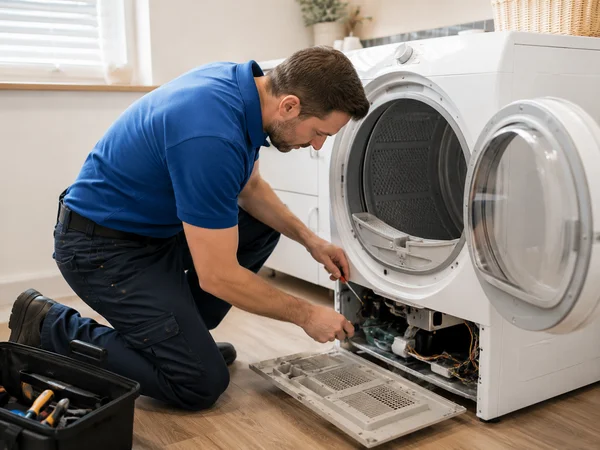
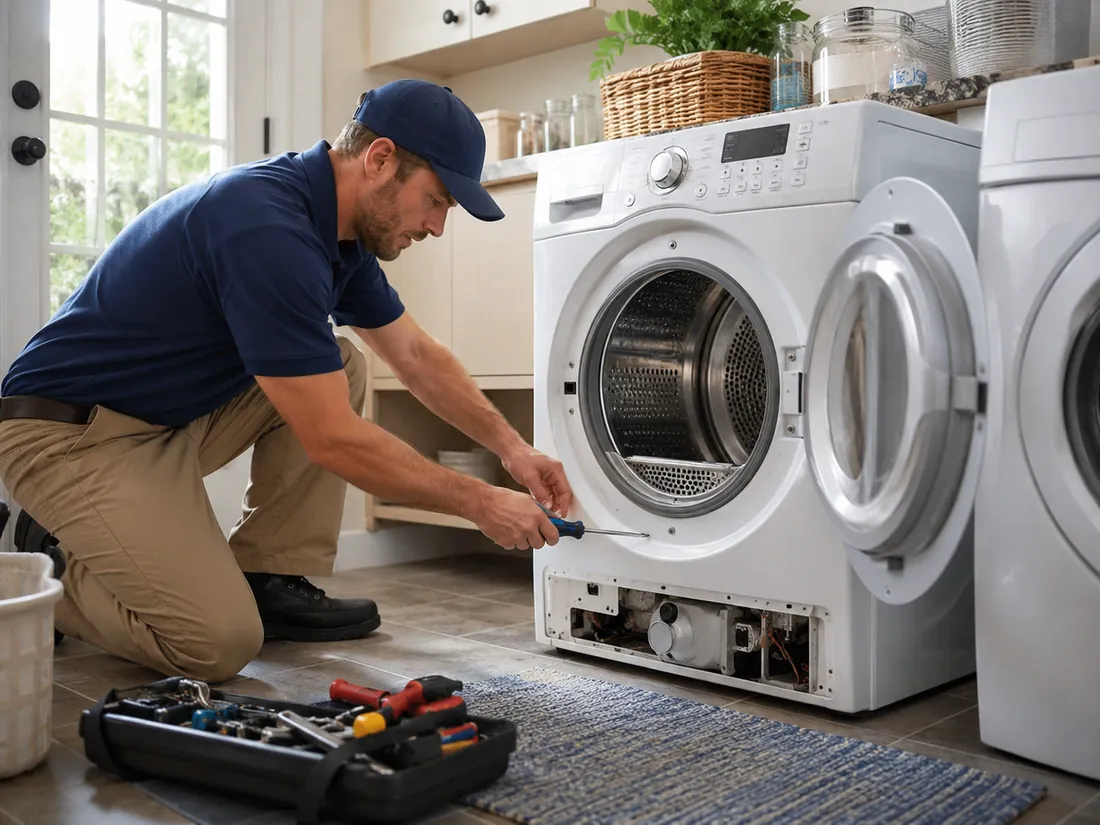
When to call a dryer repair tech
DIY gets you far with a dryer not heating, but a few situations call for a professional dryer repair tech.
Gas components. If the solenoids or igniter need replacing and you haven’t worked on gas appliances before, don’t guess. A mistake with a gas line isn’t a $40 part problem. Call a tech who carries those parts and knows the burner assembly.
Thermal fuse keeps blowing. Replace the fuse, it blows again in a few weeks — that’s a symptom, not the fix. The vent is probably blocked further back than a shop vac can reach, or the cycling thermostat is failing and letting the machine overheat. A dryer repair tech can pressure-test the vent and check the full heat circuit.
Dryer under 5 years old. A newer machine with no heat is worth a full diagnosis. Could be a simple part, but could also be a control board issue. The cost math usually favors repair over replacement at this age.
Rough pricing: thermal fuse repair runs $75 to $150 with labor. Heating element replacement is $100 to $200. Gas solenoid or igniter work runs $120 to $220 depending on the model. Compare that to $600 to $1,200 for a new dryer.
Dryer not heating in Tampa Bay, FL?
Perfect Appliance Repair Tampa handles dryer not heating calls across Tampa Bay same day. Tampa’s humidity means lint sticks to vent walls faster than most places — if your thermal fuse has blown more than once, the vent is almost always the root cause. Mike carries thermal fuses and heating elements on the truck so most repairs wrap in one visit. Upfront pricing before any work starts. Call or book online today.
Common questions about dryer not heating
Why does my dryer run but not heat?
The most common cause is a blown thermal fuse — a one-time safety device that cuts power to the heating circuit when the dryer overheats. Other causes include a burned-out heating element (electric), failed gas valve solenoids (gas), or only one leg of 240V reaching the unit. Start with the thermal fuse; it's a $10 part and takes 20 minutes to replace.
How much does it cost to fix a dryer that won't heat?
A thermal fuse replacement with labor runs $75 to $150. A heating element job is $100 to $200. Gas solenoid or igniter work falls in the $120 to $220 range. Most dryer repair calls in Tampa Bay come in under $200 for the common causes, which is well below the cost of a new machine.
Can I still use a dryer that's not heating?
You can run it, but it won't dry clothes — just tumble them cold. If the root cause is a clogged vent, running the dryer repeatedly can build up heat behind the blockage and create a fire risk. Diagnose the problem before running it again, especially if the thermal fuse already blew once.
How do I know if my dryer thermal fuse is blown?
Test it with a multimeter set to continuity. Touch the probes to each terminal on the fuse — if you get no beep or reading, the fuse is blown. A blown thermal fuse always means the dryer runs with no heat at all, not intermittent heat. It can't be reset, only replaced.
How much does a dryer heating element cost?
The part itself runs $20 to $40 for most brands — Whirlpool, GE, Samsung, LG. With labor, the full dryer repair job comes to $100 to $200 depending on the model and how accessible the element is. It's one of the more straightforward dryer repairs when you can confirm the element is the problem.